
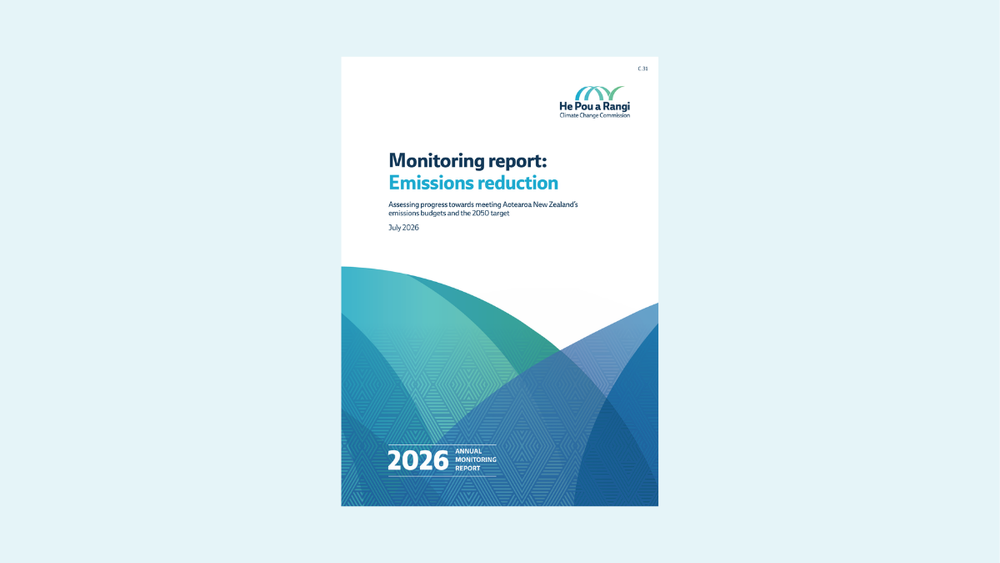
While the Commission warns that New Zealand needs to accelerate emissions reductions, examples from Toitū clients show the transition is already underway.
Organisations such as Silver Fern Farms are demonstrating that emissions reductions can go hand in hand with operational savings, energy resilience and stronger business performance, turning climate action into a competitive advantage.
In this article, we unpack the Commission's latest findings, why they matter for New Zealand businesses, and the key actions organisations should be considering now.
What just changed?
The Climate Change Commission's latest Emissions Reduction Monitoring Report (2026) warns New Zealand is at increasing risk of missing future emissions budgets and climate targets.
While emissions have declined since 2019, progress stalled in 2024 and the Commission says current policies are unlikely to deliver the reductions required for the 2030 methane target, the third emissions budget (2031-2035), or the country's 2050 target.
The message is clear: emissions reductions will need to accelerate significantly over the next decade.
Why it matters
- The pace of decarbonisation needs to more than double.
The Commission says future targets remain achievable, but only with stronger action in the next one to two years. - Operational emissions reductions are becoming more important than offsets.
Forestry can no longer provide additional buffer for the second emissions budget, increasing the focus on reducing emissions at source. - The economics of decarbonisation have changed.
The Commission highlights technologies such as heat pumps, electrification and EVs as increasingly cost-effective options for businesses. - Policy pressure is likely to increase.
As emissions targets come under greater risk, businesses should expect a stronger focus on emissions performance across energy, transport, agriculture and industry. - Resilience is becoming a commercial issue.
The report links emissions reductions directly to reduced exposure to energy price volatility, fuel shocks and future transition costs.
If you’re on the science-based Toitū Climate Impact Programme, which is accredited to internationally recognised ISO standards, you’re well supported for addressing the points listed above.
Our take
The most interesting takeaway from this report isn't only that New Zealand is behind on emissions targets. It's also that the Commission is also increasingly framing decarbonisation as an economic resilience challenge, not just an environmental one.
What's particularly notable is the report's observation that many recent industrial emissions reductions have come from lower production rather than technology upgrades or fuel switching. That highlights a critical distinction: reducing emissions by doing less is very different from reducing emissions by improving productivity and competitiveness.
That's where Toitū certified organisations like Silver Fern Farms offer an important signal.
They've demonstrated how operational decarbonisation can deliver both emissions reductions and business value. Their Belfast site heat pump and electrification upgrades are on track to reduce emissions by more than 60% compared with baseline while delivering operational savings of more than 16%. The heat pump alone contributes annual reductions of 1,940 tCO₂e, with full electrification avoiding a further 1,472 tCO₂e each year.
The bigger pattern is emerging: the businesses that move early on proven technologies will reduce emissions faster, and are likely to be better positioned to manage future energy costs, carbon constraints, and respond to market expectations.
What to do next
Set, or review and strengthen, your emissions reduction targets and ensure they're supported by a clear, practical implementation plan to help you achieve them.
Start by focusing on:
- Identify where fuel switching, electrification or energy-efficiency investments could deliver both emissions and cost reductions.
- Reassess climate initiatives through a resilience and productivity lens, not just a compliance lens.
- Look for proven examples within your sector that demonstrate how emissions reductions can support operational performance and long-term competitiveness.
Read more about how climate resilience adds commercial value in this recent article.
Closing thoughts
The Climate Commission's report is ultimately a reminder that the challenge facing New Zealand is not whether emissions reductions are possible, but how quickly they can be scaled. The encouraging news is that many of the technologies and solutions required already exist and are delivering results today.
As organisations like Silver Fern Farms demonstrate, reducing emissions does not have to come at the expense of performance. Increasingly, the businesses leading the transition are finding ways to lower emissions, strengthen resilience and improve operational efficiency at the same time.
If you’re a Toitū client and would like to discuss the role of decarbonisation, operational efficiency and competitiveness in your climate strategy — reach out to your dedicated Programme Lead or our Client Support Team at support@toitu.co.nz, or call 0800 366 275 (option 2) at any time.
Contact us
Turn your climate ambition into real business impact. Contact a Toitū sector expert and explore our leading certification and advisory options today.

Javier Aylwin
Primary Industries, Manufacturing & Transport

