

Overview
In this Toitū Explainer, you'll learn what Sustainable Aviation Fuel (SAF) certificates are, how they work, and why they matter. We'll walk through the basic concepts, explain the role SAF certificates play in supporting aviation decarbonisation, and answer some of the common questions organisations have about their use.
What are SAF certificates?
Sustainable Aviation Fuel (SAF) certificates are a market mechanism that allows organisations to support the use of lower-emissions aviation fuel without physically purchasing or using that fuel themselves.
They are typically used through a book-and-claim system, which separates the environmental benefits of sustainable aviation fuel from the physical fuel itself. This enables organisations to financially support SAF deployment, even when SAF is not available at the airport they use or on the flights they take.
SAF certificates are typically purchased because they represent actual aviation-sector decarbonisation and can support value chain air-travel emissions reduction claims.
Why do they matter?
Aviation is one of the most challenging sectors to decarbonise. While aircraft efficiency improvements, operational changes and emerging technologies can help reduce emissions over time, sustainable aviation fuel is currently viewed as one of the most significant near-term opportunities to reduce aviation emissions using existing aircraft and infrastructure.
However, SAF supply remains limited and is generally more expensive than conventional jet fuel. SAF certificates have emerged as a way to help create demand and support market growth while supply scales.
How SAF certificates work
What is a SAF certificate?
A SAF certificate represents the verified emissions reductions associated with a defined quantity of sustainable aviation fuel that has been produced and consumed.
Through a book-and-claim system, these verified environmental attributes can be separated from the physical fuel and transferred independently.
The certificate can be purchased separately from the physical fuel, enabling organisations to support SAF deployment regardless of where the fuel is used.
Why use the book-and-claim model?
SAF is currently produced in limited volumes and is not available at every airport.
Without a book-and-claim approach, only organisations with access to airports receiving SAF could participate in supporting its adoption.
Book-and-claim allows organisations to:
- Participate regardless of where their flights occur
- Track sustainability attributes through a verified system
- Support demand for sustainable aviation fuel
- Contribute to aviation sector decarbonisation
- Claim flight emissions reductions using market-based reporting
How the SAF certificate book-and-claim model works
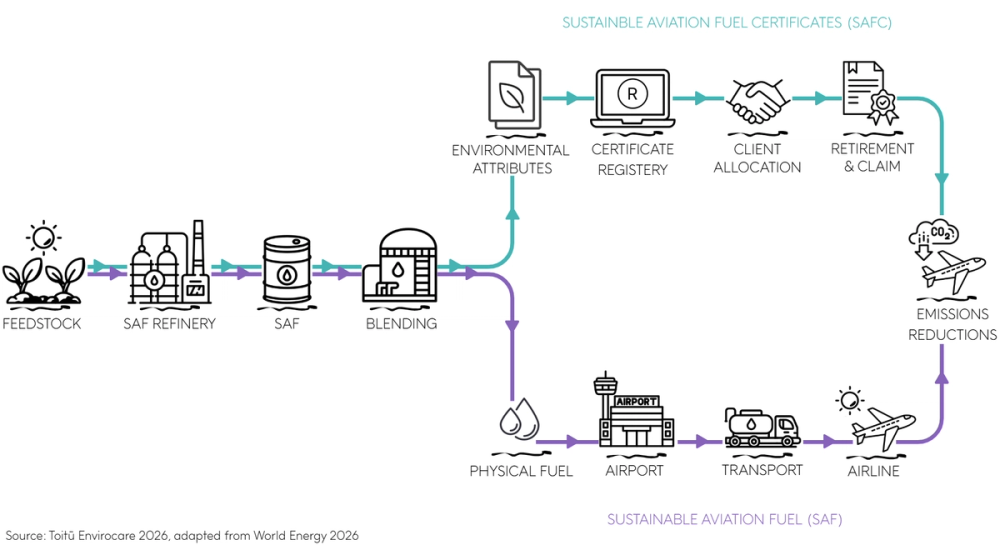
Example
A company headquartered in New Zealand regularly flies employees internationally.
SAF may not be available at the airports or on the flights used by the company's travellers. Through a SAF certificate programme, the company can contribute to the uptake of sustainable aviation fuel elsewhere in the aviation network.
Although the physical fuel is not used on the company's specific flights, the environmental attributes associated with the fuel are independently verified, tracked and transferred through a book-and-claim system. This enables the organisation to support aviation sector decarbonisation while helping stimulate demand for lower-emissions aviation fuel.
Why SAF certificates exist
The challenge
Sustainable aviation fuel is not yet widely available across global aviation networks.
Key barriers include:
- Limited production capacity
- Higher costs compared with conventional jet fuel
- Uneven distribution across airports and regions
- Growing demand from airlines and corporate customers
As a result, many organisations are unable to directly access or purchase SAF for their own air travel activities.
The role of certificates
SAF certificates were developed to help address this accessibility challenge.
They enable:
- Broader participation in SAF markets
- Demand signalling from organisations that want to support aviation decarbonisation
- Financial support for increased SAF production
- Participation regardless of flight routes or airport infrastructure
Market context
Book-and-claim systems have been used and are being developed in other sectors where environmental attributes can be tracked independently from physical products.
Examples include:
- Renewable energy certificates (established and broadly accepted)
- Low emission freight certificate (in development)
- Sustainable marine fuel certificates (in development)
SAF certificates apply a similar concept to aviation fuel. The credibility of this approach depends on robust governance, transparency, and high-integrity standards that ensure certificates represent genuine environmental benefits.
Like other environmental attribute markets, SAF certificate schemes are intended to help scale emerging low-carbon technologies by creating demand and investment signals. As SAF production increases and becomes more widely available, the need for certificates is expected to diminish, with environmental benefits increasingly delivered through direct SAF use rather than market-based mechanisms.
Potential benefits
Increased accessibility
Organisations can participate in SAF markets even when physical SAF is unavailable on their routes or at their airports.
Demand signaling
Certificate purchases may help demonstrate market demand for sustainable aviation fuel, potentially supporting future investment and production.
Scalability
The model allows participation from organisations across different regions and sectors without requiring direct fuel procurement.
Support for aviation decarbonisation
SAF certificates provide a mechanism for organisations seeking to engage with efforts to reduce aviation-related emissions.
Potential challenges
Traceability and accounting complexity
Robust systems are needed to prevent double counting, ensuring emissions reductions are accurately tracked and that claims are not counted more than once.
Evolving standards
The SAF certificate market is still developing, with approaches, methodologies and governance frameworks continuing to mature.
Risk of overclaiming
Clear rules are needed around how organisations communicate certificate purchases and associated emissions claims.
Supply constraints
The availability of SAF certificates is ultimately linked to the limited supply of sustainable aviation fuel.
Frequently asked questions
How is the credibility of a SAF certificate maintained?
Credibility relies on robust climate certification, lifecycle greenhouse gas accounting, independent verification, registry tracking, and other controls that help prevent double counting or multiple claims against the same certificate.
Are SAF certificates used globally?
Yes. SAF certificate programmes are being developed and adopted in several markets as organisations, airlines and fuel suppliers explore mechanisms to scale SAF demand and deployment.
Can SAF certificates be recognised within Toitū programmes?
SAF certificates may be recognised within Toitū Climate Impact Programmes where applicable programme requirements are met. Specific eligibility criteria, evidence requirements and claim rules are outlined in programme guidance.
Air New Zealand SAF certificates are recognised on our programmes, you can see this case study for more information.
How much does a SAF certificate cost?
The cost of a SAF certificate varies depending on the provider, route, certificate volume, and market conditions. As SAF supply remains limited globally, certificates currently attract a premium compared with conventional aviation fuel. Organisations should contact their SAF certificate provider directly for current pricing information.
What claim can an organisation make after retiring SAF certificates?
Depending on the certificates purchased, organisations may be able to communicate that they have used SAF certificates to reduce the Scope 3 emissions associated with their business air travel and supported the uptake of Sustainable Aviation Fuel within the aviation sector under market-based reporting. An example could be:
"During FY26, we used SAF certificates to match 100% of our Scope 3 business air travel emissions. This investment supports the uptake of Sustainable Aviation Fuel and emissions reductions within the aviation industry."
Key concepts
Sustainable aviation fuel (SAF)
A fuel produced from alternative feedstocks and processes that can deliver lower lifecycle greenhouse gas emissions than conventional fossil-based jet fuel.
Sustainable aviation fuel (SAF) certificates
Sustainable aviation fuel certificates are a market mechanism that allows organisations to support the use, and claim the attributes, of lower-emissions aviation fuel without physically using that fuel themselves.
Book-and-claim system
A chain-of-custody approach that separates the environmental attributes of a product from its physical delivery.
The purchaser receives accounting rights to the environmental attributes associated with the product, even if they do not physically receive or consume the product.
Chain of custody
The process used to track products and associated environmental claims as they move through a supply chain. Helping ensure claims are credible and not double counted.
Market-based reporting
An emissions accounting method that reflects the environmental attributes associated with contracts or certificates purchased by an organisation.
For SAF certificate programmes, market-based accounting enables organisations to report the lifecycle emissions reductions linked to retired SAF certificates through a recognised book-and-claim system.
Market-based reporting is distinct from activity-based reporting, which reflects emissions from an organisation's actual operations and activities.
Scope 3 emissions
Indirect emissions that occur throughout an organisation's value chain.
For many organisations, business travel emissions are commonly reported as Scope 3 emissions.
Environmental attributes
The quantified environmental benefits associated with a product or activity, such as the lifecycle greenhouse gas emission reductions related to SAF.
Additionality
The concept that an activity creates outcomes that would not have occurred otherwise.
In discussions about SAF certificates, additionality often relates to whether certificate purchases help stimulate additional SAF production or investment.
Summary
Key takeaways
- SAF certificates are a mechanism that enables organisations to support sustainable aviation fuel without directly purchasing the physical fuel.
- They commonly operate through a book-and-claim system, where environmental attributes are separated from fuel delivery.
- SAF certificates were developed to help overcome challenges such as limited SAF availability and higher costs.
- They can help broaden participation in aviation decarbonisation efforts and signal demand for sustainable aviation fuel.
- As the market continues to evolve, robust tracking, accounting and governance systems remain important considerations.
Next steps
Now you know what SAF certificates are and how they work. For guidance on their credibility and appropriate use, Toitū Climate Impact Programme members can see our SAF Certificate Position Statement and Guidance.
Toitū's requirements are designed to support the use of high-integrity SAF certificates, providing confidence that market-based claims are backed by credible and verified environmental outcomes.
Contact us
Turn your climate ambition into real business impact. Contact a Toitū sector expert and explore our leading certification and advisory options today.

Javier Aylwin
Primary Industries, Manufacturing & Transport

